Georgian Parliamentary Delegation Attended the 33rd General Assembly of the Interparliamentary Assembly on Orthodoxy
Media and Society 22 Jun 2026
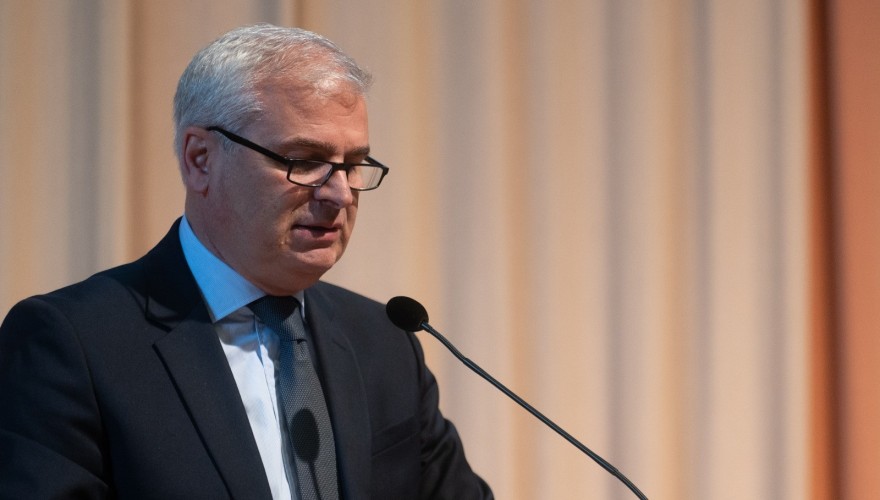
A delegation of the Parliament of Georgia attended the 33rd General Assembly of the Interparliamentary Assembly on Orthodoxy in the Finnish capital. The delegation was led by Irakli Kadagishvili, Chair of the Regional Policy and Self-Government Committee, and included Zaza Lominadze, Chair of the Health Care and Social Issues Committee.
The parliamentary forum, held in Helsinki under the theme “The Situation of Christian Minorities in Times of Crisis: Relations Between Society, the State, and the Church – Difficulties and Challenges,” brought together parliamentary delegations from 15 countries, representatives of international organizations, and specially invited guests.
The General Assembly was opened by Jussi Halla-aho, Speaker of the Parliament of Finland, who highlighted the importance of the issues to be discussed during the Assembly.
In his address, Irakli Kadagishvili focused on the challenges faced by the population living in Georgia’s occupied territories.
“We have gathered to discuss the challenges facing Christian minorities living in crisis situations, as well as issues concerning relations between society, the state, and the Church. For Georgia, this topic is particularly painful in relation to the occupied territories of Abkhazia and the Tskhinvali region.
These historic regions of Georgia were, for centuries, home to Georgian Christian communities, where the Orthodox faith formed an integral part of local cultural and spiritual identity. As a result of the armed conflicts of the 1990s, ethnic cleansing, carried out in both regions, and Russia’s aggression and occupation in August 2008, hundreds of thousands of ethnic Georgians were forced to leave their homes. Consequently, the demographic landscape of these regions changed dramatically, and many historic Christian communities were deprived of the opportunity to continue their centuries-old presence in their native land.
The weakening of historical memory and the gradual alienation of the local population from its religious and cultural heritage have affected both occupied regions and endangered the preservation of centuries-old Christian monuments. Today, ethnic Georgians remaining in the occupied territories continue to face difficulties related to their ethnic and religious identity. They live in conditions of isolation, have limited access to Georgian cultural and religious heritage, and are subjected to constant pressure, which hinders their ability to fully preserve their identity.
This challenge is clearly reflected in the condition of Georgian Christian cultural heritage located in the occupied territories. In Abkhazia, significant monuments such as the Bedia Monastery, Ilori St. George’s Church, Pitsunda Cathedral, and the tomb of Apostle Simon the Canaanite in the village of Kamani are not only outstanding examples of Christian architecture and heritage but also living testimony to the centuries-long presence of Georgian Christian communities in the region”, - he stated.
According to Kadagishvili, the issue extends beyond the protection of historical monuments and concerns the preservation of historical memory, spiritual heritage, and identity.
He noted that international experience demonstrates that protests and political statements alone are often insufficient to ensure effective protection. Even today, in various regions of the world, including the Middle East and territories affected by prolonged conflicts, Christian minorities continue to face persecution and restrictions on religious freedom.
“We need effective policies and institutions that will protect the rights related to religious and ethnic identity, ensure the full participation of these communities in public life, and promote respect for historical and cultural heritage. At the same time, Christian minorities must have a real and meaningful voice in public dialogue and in the decision-making processes that shape their future.
Our common objective is to fully utilize international legal and parliamentary mechanisms to address these challenges. In this regard, particular importance is attached to Article 17 of the Treaty on the Functioning of the European Union, introduced by the Treaty of Lisbon, which establishes a legal framework for open and regular dialogue between the European Union and religious organizations.
Georgia is ready to actively contribute to these efforts, drawing on its historical experience and commitment to European integration”, - he noted.
At the conclusion of the session, members of the Parliamentary Assembly adopted a resolution on the issues discussed during the event.