Shalva Papuashvili Delivered Address at the First Conference of Speakers of the Parliaments of EU Candidate Countries
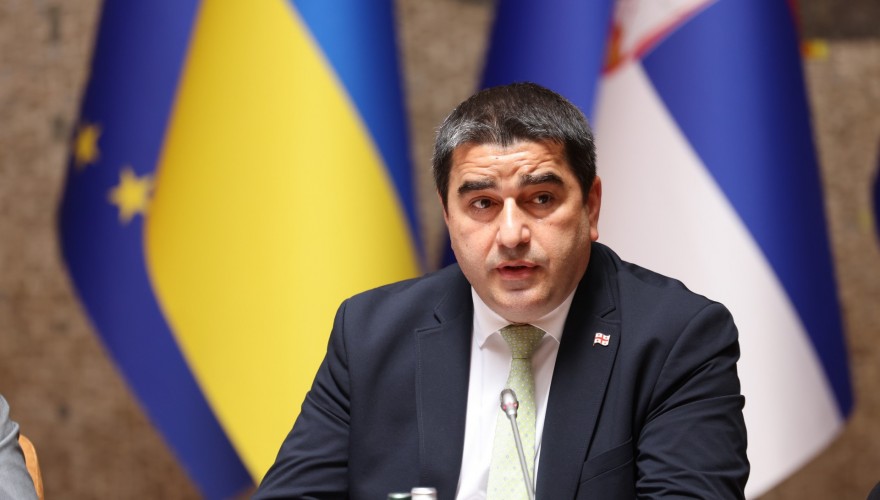
"I would like to thank the National Assembly of Serbia and the Verkhovna Rada of Ukraine for initiating and hosting this first meeting of the Speakers of the Parliaments of the European Union candidate countries”, - said the Speaker of the Parliament of Georgia, H.E. Shalva Papuashvili, while addressing the First Conference of Speakers of the Parliaments of EU Candidate Countries in Serbia.
As Shalva Papuashvili noted, it is of utmost importance that the parliaments of candidate countries also become involved in coordinating efforts towards EU integration.
"While governments conduct the negotiations, it is parliaments that provide democratic legitimacy to European integration. On behalf of the Parliament of Georgia, I would like to share several messages with my colleagues.
First, EU enlargement is the principal means of ensuring Europe's future strategic viability. The new political and economic realities of today's world, global competition, and the shifting balance of power require the European Union to adopt a new approach to enlargement. For decades, the concept of 'Fortress Europe'—which envisages development without enlargement—may have prevailed, but today it is no longer a viable option. The title of our meeting, 'Shaping Europe's Future Together', accurately reflects this understanding: candidate countries should be regarded as participants in the enlargement process, not merely as its objects. The European Union can no longer afford to perceive itself as an exclusive club deciding whether or not to bestow the 'grace' of accession upon candidate countries. On the contrary, the time has come for the European Union to take seriously its own well-established, yet now overused, metaphor that 'it takes two to tango.’
Second, the enlargement process must remain merit-based. The achievements and progress of each candidate country should be assessed fairly, consistently, and on the basis of a predictable approach. The conditions should be clear, progress properly acknowledged, and intermediate benchmarks should not be altered to serve political objectives. Unfortunately, however, individual EU Member States—or, even more surprisingly, Brussels itself—occasionally introduce new and unforeseen preconditions. Such unexpected demands artificially hinder the progress of candidate countries. These preconditions often resemble political blackmail rather than a constructive approach. It is evident that they frequently stem from electoral cycles within the European Union, domestic political narratives, or disputes related to history and identity. No candidate country can, on its own, effectively counter the asymmetrical power of an EU Member State, knowing that any Member State may block its progress on subjective grounds. Therefore, we must stand by one another in overcoming these unjustified obstacles.
Third, we must avoid creating the impression that candidate countries are competitors rather than partners. Such fragmentation only weakens us. When we confront challenges individually, our voice becomes weaker, our influence diminishes, and it becomes easier for the enlargement process to be delayed, politicised, or prolonged indefinitely. We must not allow this parliamentary format of candidate countries to become a forum for ranking countries, lecturing one another, or discussing bilateral disputes. Instead, it should serve as a platform for practical cooperation and the development of joint initiatives.
The Joint Declaration that we intend to adopt today clearly states that we have gathered here for unity, not division—and the Parliament of Georgia fully subscribes to this message”, - Shalva Papuashvili stated.
According to him, the best way to strengthen the European Union's currently weakened geopolitical and economic position is through enlargement into strategically vital geopolitical regions—the Balkans and the Black Sea region.
"That is precisely why the European Union should view enlargement not as a burden or an act of charity, as some portray it, but as a historic opportunity for renewal and for restoring its global leadership. As Georgia's national motto reminds us, ‘Unity Makes Strength.' Let us therefore use this meeting to shape our European future together”, - the Speaker of the Parliament of Georgia concluded.