
Producers of Food Products Were Heard at the Sitting of the Interim Commission Studying the Structure of Price Formation for Food Products, Medicines, and Fuel
Media and Society 19 Feb 2026
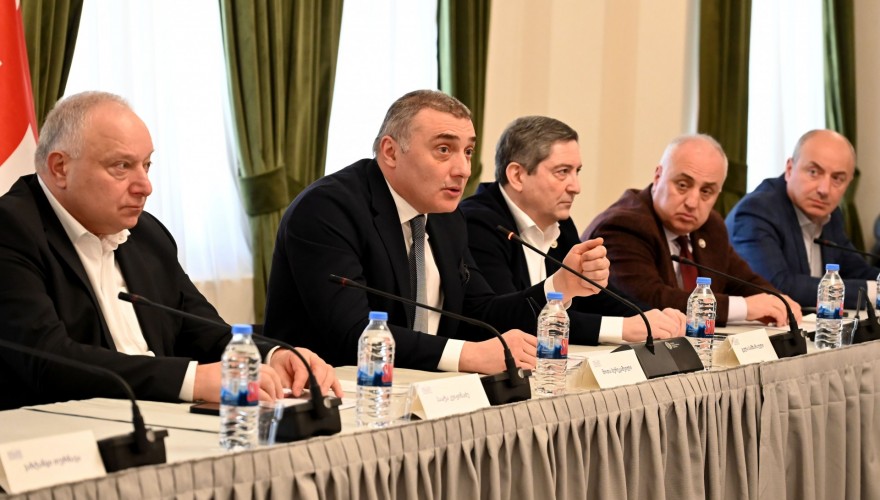
At the sitting of the Interim Commission Studying the Structure of Price Formation for Food Products, Medicines, and Fuel, members of the Commission heard representatives of food-producing companies.
The Chair of the Commission, Shota Berekashvili, summarized the outcomes of the previous two sessions and spoke about the problems and challenges affecting the factors of price formation for locally produced goods.
“I would like to highlight several important factors: first, a large portion of production depends on imported raw materials, which in itself creates inflationary risks. Second, there has been a significant increase in operating costs, particularly in sales and distribution expenses, which are directly linked to relations with retail chain stores. This means that it is particularly costly for producers to market their products. We have also observed that, in some cases, there is a shortage of working capital, forcing producers to obtain additional credit resources, which increases capital costs, as credit resources amount to 15–16%. Ultimately, all of this is reflected in consumer prices”, - Shota Berekashvili stated.
According to him, the existing price formation chain and business operations place local production in a non-competitive environment, which is ultimately reflected in the price of produced goods.
“Our objective is to increase the competitiveness of local production. This is a matter of particular importance for us, because under conditions of healthy competition with imported goods, proper management of business processes, and increased business efficiency, we seek to make local production competitive, which will ultimately be reflected in competitive pricing”, - he noted.
Representatives of “MCB Georgia,” “Vasadze’s Bread,” and “Barambo” spoke about their relations with retail trade networks and highlighted the problems associated with placing and selling their products in retail chains.
According to them, retail chains occupy a privileged position vis-à-vis manufacturing companies, enabling them to unilaterally terminate contracts related to product placement in stores.
They also noted that the so-called “cash-back” system, which increases annually, represents a significant problem.
While discussing problematic issues, local producers emphasized concerns related to imported products, inventory management within chain markets, and delayed payments, which compel companies to turn to banks for financing.
Representatives of LLC “Jolio,” “Sweet Country,” “Marneuli Food Factory,” and JSC “Georgian-European Pasta Industry” also spoke about similar challenges.
According to them, in addition to relations with retail chains, companies face significant burdens stemming from challenges in the production process, utility and fuel costs, and dependence on imported products.
The Chair of the Commission also spoke about the issues identified during meetings with local producers.
“The increase in prices of locally produced goods is driven by various problems, which became clearly evident during meetings with producers. It should be noted that the markup involves a three-tier process consisting of the producer, the importer-distributor, and retail network operators. There is a close interconnection among these three tiers, and therefore, it is impossible to speak about a final solution until all three levels have been thoroughly examined. Today we have concluded meetings with local manufacturing companies, and at subsequent sessions of the Commission, we will continue meetings with importers and distributors”, - Shota Berekashvili stated.