
The Interim Commission of the Parliament of Georgia Studying the Structure of Price Formation of Food Products, Medicines and Fuel, heard the Producers of Fruit Products and Juices
Media and Society 13 Feb 2026
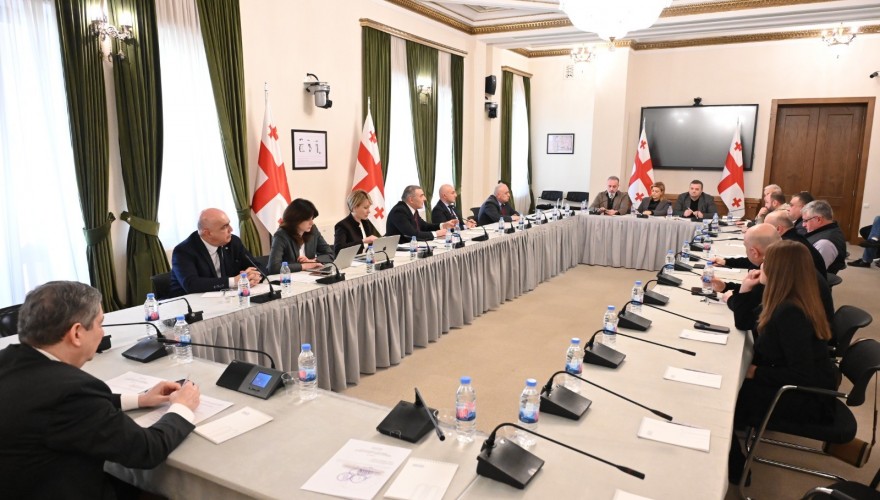
The Interim Commission of the Parliament of Georgia studying the structure of price formation of food products, medicines, and fuel continues its meetings with representatives of local companies and producers. At today’s sitting, Commission members heard representatives of the limited liability companies “Planta”, “Tirifoni Gardens”, “Kalakuri”, “Anigozi”, “Achinebuli”, “Milmart”, and “Georgian Agroproduct”.
At the beginning of the sitting, the Chair of the Commission, Shota Berekashvili, spoke about the objectives and tasks behind the establishment of the Commission, as well as the expected outcomes of its work.
“We are currently at the stage of identifying problems. The next stage will involve analytical work, and finally, the activation of appropriate instruments that will enable us to make the sector more competitive and efficient. It is important to identify the structural problems within the sector and apply a systemic approach to resolving them, which will ultimately have a positive impact both on consumers and on all stakeholders involved in the sector, and will allow us to achieve a significant downward correction of prices”, - Shota Berekashvili stated.
The producers highlighted issues related to placing their products on the shelves of retail chains and to operational costs. According to representatives of hazelnut and walnut producing companies, one of the major challenges they face is the imposition of non-competitive prices by international companies, the import of raw materials into Georgia, and an uneven competitive environment.
While discussing problematic issues, representatives of fruit and vegetable processing companies focused on challenges related to placing locally produced goods in retail chains and receiving payment for sold products.
According to Gocha Gvinefadze, Director of LLC “Achinebuli”, 85–90% of the company’s products are sold through retail chains; however, the markup applied to their products places a heavy burden on the company.
“If the company sets price X for a product, the store adds 30–40%. In addition to this markup, we are required to pay approximately 45%, of which 20% constitutes the so-called ‘cashback.’ We also pay a marketing fee of 15%, a loyalty fee of 1%, a digital services fee of 1%, and logistics costs of 7.5%. In addition, there are entry fees, shelf placement fees, and value-added tax. Ultimately, the product price increases by 185%”, - Gocha Gvinefadze noted.
Representatives of “Milmart” and “Georgian Agroproduct” also spoke about similar problems.
According to Giorgi Maisuradze, Director of “Milmart”, relations with retail chains have deteriorated year by year, and the company has suspended product deliveries to them for the past four months. As he noted, products manufactured by Georgian companies have lower recognition among the local population because they are not easily placed on store shelves.
According to Ioseb Manjavidze, Director of LLC “Georgian Agroproduct”, three retail chain companies terminated their cooperation with the producer and returned the products.
“The fruit and vegetable processing enterprise, which produces natural fruit purées and juices, was originally opened with state assistance and support. Due to problems with local retail chains, we are compelled to export our products, and in this process the state supports us”, - Ioseb Manjavidze stated.
Commission members thanked local producers for their frank discussion.
“Within the framework of an open discussion, hearing the views of representatives of local companies is both interesting and noteworthy. We heard numerous problems at the sitting: a lack of working capital and the high cost of capital; high marketing and sales expenses; asymmetric contractual relations between the parties, which grant excessive bargaining power to the upper tier; delayed payments and inefficient inventory management. In this process, it is crucial to study the entire price formation chain; to correctly identify the problems; and, through an analytical approach and assessment, to activate effective mechanisms that will lead to significant results”, - Shota Berekashvili stated.