
Shalva Papuashvili: We Must Remember That Silence, Indifference, and Inaction Were the Main Preconditions That Made the Holocaust Possible. We Must Not Tolerate Any Manifestation of Hatred
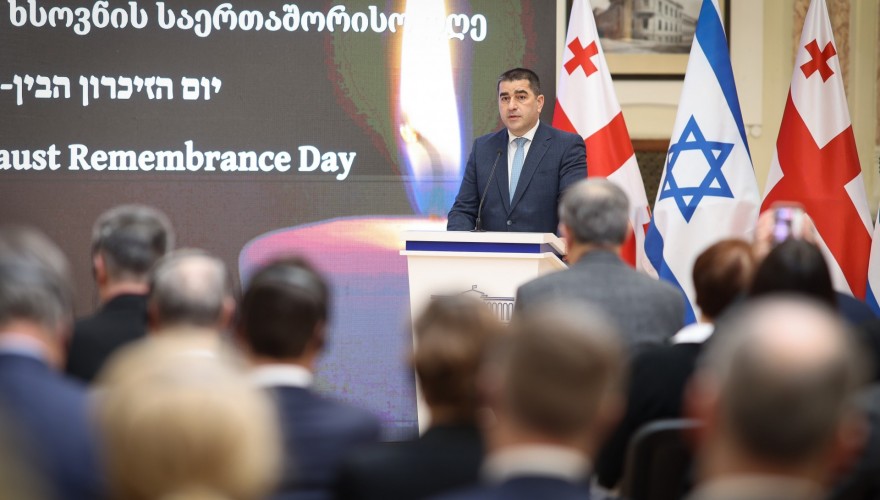
“Today we commemorate Holocaust Remembrance Day and join the entire civilized world, for which this day represents the peak of criminality that humanity experienced in the twentieth century,” stated the Speaker of the Parliament, H.E. Shalva Papuashvili, during his address at an event dedicated to the International Holocaust Remembrance Day.
As Shalva Papuashvili noted, the extermination of six million Jews is an indelible tragedy that shook Europe and permanently burdened the collective consciousness of humanity.
“This is the memory of innocent people who became targets of destruction solely because they belonged to a particular ethnic group. It was a denial of humanity, a devaluation of life, and an attempt at the self-destruction of civilization.
No political circumstance can overshadow the pain inflicted upon the Jewish people, families, and civilization. That is why every year we commemorate the victims of genocide and recall both the victims and the scale of the tragedy, as well as the circumstances that allowed such brutality to occur. We live in a rapidly changing and dynamic world.
Generations change, memory changes, and everyday life covers the wounds of the past. History becomes compressed, lessons fade into oblivion, and new generations struggle to comprehend the essence of the past. Tragedy is reduced to a single word or phrase, loses its magnitude, and becomes instrumentalized according to the needs of current political discourse.
For this reason, Holocaust Remembrance Day must not be merely a symbolic gesture. It must be a moment of loud reminder and a clear statement, when we describe precisely and by name what happened, why it happened, what allowed this evil to occur, and what consequences it brought to humanity. Speaking about the victims of the past remains important today, because we clearly see a number of developments that remind us of that era, when arrogance, hatred, violence, revenge, and the demonization of difference gave rise to a methodical and sophisticated machine for the destruction of an entire nation—a machine that required the shedding of immense blood to be stopped,” - Papuashvili stated.
The Speaker also spoke about the contribution of Georgians to the defeat of fascism, noting that discord, hostility, and hatred can never possess any form of legitimacy, nor can their instigators ever be justified.
“The contribution of Georgians was also significant in defeating this evil. We are proud not only of the victory that came with the defeat of fascism, but also of our national consciousness, which accepts diversity, welcomes all guests, and shows compassion toward the weak and the oppressed. This is the value-based foundation that preserved the human face of Georgian society even during the most difficult periods of history.
In this context, it should be recalled that the 26-century-long tradition of Georgian–Jewish relations was granted the status of intangible cultural heritage of national significance six years ago. This relationship will continue for many centuries to come and will endure as long as this world exists. This is our loud and confirmed statement. We are clear and direct when it comes to values, humanism, traditions, and ideals. We speak about this within our country and call for the same beyond our borders, wherever we see regression.
We must remember that silence, indifference, and inaction were precisely the main preconditions that made the Holocaust possible. We must not tolerate any manifestation of hatred, must not normalize it, and must not believe that hostility can bring about anything good. Discord, animosity, and hatred can never be healthy, and there can be no justification for those who incite, sow, or manipulate them. That is why very clear red lines must be drawn between what is permissible and impermissible—because it begins with something small and ends globally; a small weed is sown and a poisonous bush grows; it starts with a spark and results in a fire. The Holocaust is the most severe and tragic reminder of this path.
No final solution can ever be achieved through division, violence, war, or suffering. War gives rise to war; violence breeds violence. That is why civilization must always stand on the side of peace, seek balance and equilibrium, and build relations based on mutual respect, tolerance of difference, and a clear understanding of the boundaries between what is acceptable and unacceptable. This is our main message today,” - Shalva Papuashvili stated.
At the event held at the National Library of the Parliament of Georgia, the invited guests were also addressed by the Ambassador Extraordinary and Plenipotentiary of the State of Israel to Georgia, H.E. Mr. Walid Abu Haya.
Within the framework of the event, a presentation was held for a Holocaust remembrance competition implemented by the Embassy of Israel with the support of the Ministry of Education, Science, and Youth of Georgia.
The event dedicated to the International Holocaust Remembrance Day was attended by Members of Parliament, representatives of the executive branch, members of the diplomatic corps accredited in Georgia, and the Public Defender.