
Shalva Papuashvili introduced the Annual Report on the Activities of the Parliament of Georgia
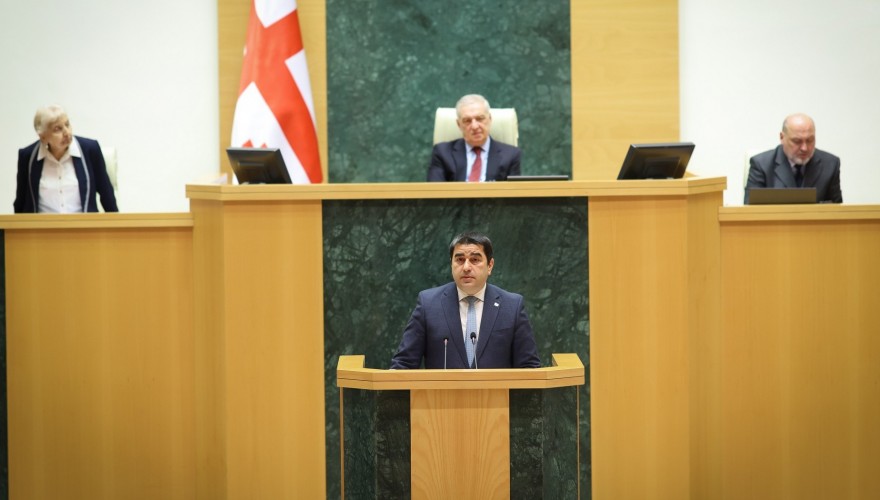
The Speaker of the Parliament of Georgia, H.E. Shalva Papuashvili, introduced the annual report on the Parliament’s activities at a plenary session. According to Mr. Papuashvili, the Parliament continues to work to fulfill the mandate granted by the Georgian people in the 2024 elections.
“The 11th convocation of Parliament has now been working, on behalf of the Georgian people, for its fourth session, serving the interests of the public, working to fulfill the rights and responsibilities entrusted to us by our electorate, the population of Georgia, through the 2024 elections. These elections, which were framed as a referendum and given an existential dimension, were ones on which hostile forces toward Georgia placed their bets, seeking to alter the course of our country’s history, to impose a false agenda wrapped in shiny packaging instead of the real one, and to deceive us. However, the Georgian people did not make a mistake. 54% of voters—1,120,000 citizens of Georgia—supported a peaceful, stable, strong, sovereign, and independent future for Georgia, a future clearly and firmly embodied by “Georgian Dream”, - he stated.
According to him, one year ago, when presenting the previous report, there was no representation of the radical opposition in Parliament, as they had resorted to a completely unconstitutional, undemocratic, and, as time has shown, ineffective form of parliamentary sabotage by refusing the mandates granted to them by the people.
“Today, there is one more opposition group in Parliament, in the form of the ‘For Georgia’ faction. However, we also see that this faction is trapped in uncertainty, just like the rest of the radical extra-parliamentary opposition. They simultaneously wish to be members of the Parliament elected by Georgia and at the same time refuse to recognize the legitimacy of that elected Parliament. We heard that their goal in entering Parliament was a ‘life-and-death struggle’ against the government, but ultimately they found themselves sidelined, hostage to their own dual political stance”, - Shalva Papuashvili stated.
As the Speaker explained, the main achievement of the current convocation of Parliament—one it can take pride in—is the adoption of laws of historic significance for strengthening democracy and restoring institutional arrangements within the constitutional framework.
“The direct mandate of the people over the legislative process has been significantly strengthened. Today, laws are adopted by a national legislative body elected by the people, which no longer has to share its democratic mandate with unelected groups, often funded opaquely from abroad, which fundamentally contradicted the essence of democracy.
The institutional changes implemented by the Parliament of Georgia in recent times have been of great importance. In the past, we faced imposed tendencies of hollowing out and fragmenting the powers of constitutional bodies. Today, this practice is changing. Among other reforms, the Special Investigation Service was abolished and its functions were transferred to the Prosecutor General’s Office of Georgia, while the functions of the Personal Data Protection Service and the Anti-Corruption Bureau were integrated into the State Audit Office”, - the Speaker stated.
According to him, eight months ago, a new Rules of Procedure of the Parliament of Georgia came into force, which has already fundamentally improved the effectiveness and substance of parliamentary work.
“I would particularly highlight the strengthening of Parliament’s oversight function. For example, since the new Rules entered into force, interpellation—especially that of the Prime Minister—has become not an exception but almost a daily practice of parliamentary life.
Within the framework of the amendments, non-systemic and artificial instruments previously used for oversight were also abolished. Instead of councils and thematic inquiries, the constitutional instrument of an interim fact-finding commission has been activated for the first time. Currently, two such commissions have been established in Parliament: one on women’s and children’s issues and another on price monitoring. Society has closely followed the intensity of their work.
Alongside its legislative and oversight functions, the Parliament of Georgia has traditionally remained the epicenter of political life. Against the backdrop of wars and conflicts in the region and beyond, this role is becoming increasingly significant”, - Shalva Papuashvili noted.
In his assessment, the past year has brought fundamental shifts in international politics. As national interests come to the forefront, it is now clear that the world is no longer divided into black and white geopolitical categories, and mechanical labels such as pro-Western or anti-Western, pro-Russian or anti-Russian have faded.
“Today, there is only one defining measure—pro-Georgian or anti-Georgian. Any ‘pro-orientation’ other than Georgian ultimately becomes non-Georgian, as it distances the country’s policy from its national interest and turns it into an instrument of others’ goals. This must be stated openly, clearly, and decisively: in governing our country, there is no pro-European or anti-European, pro-Western or anti-Western, pro-Russian or anti-Russian. There is only being Georgian or anti-Georgian—loyalty to national interests or betrayal of them”, - the Speaker stated.
According to him, Georgia is an integral part of Europe. Its values, ideas, and aesthetics are neither borrowed nor artificially adopted; they are an organic part of Georgia’s history, culture, and identity.
“For us, Europe is not a geopolitical project or a bureaucratic union, but a value-based and civilizational space, one shaped also by Georgians. The European Union is one manifestation of Europe—it is neither the first nor the last.
The fact that Georgia is not a member of the European Union does not mean that Georgia is not Europe or is any less European than others. Therefore, we cannot accept a mentoring tone from Brussels or any EU capital regarding European values—values that Georgia has often defended alone during the most difficult periods of history.
The slogan ‘I am Georgian, therefore I am European!’ was a product of its time, when the Iron Curtain created such a geopolitical, institutional, and economic gap between Georgia and Europe that the word ‘therefore’ seemed necessary. Today, Georgian Europeanness no longer requires justification, as it is self-evident that Georgia, a co-creator of Europe, is itself Europe”, - he stated.
He added that EU membership should not grant anyone the right to speak to the Georgian people in a patronizing tone or dictate their choices.
“For this reason, the primary responsibility for the current tensions between Georgia and the European Union lies with those European leaders who have turned this relationship into a hostage of their own political agendas. This situation must change.
Brussels knows very well what steps are necessary to restore relations with Georgia to a dignified framework. First and foremost, the EU must respect democracy—the rule of the people. Imposing political will from outside or attempting to create a ‘surrogate’ of the Georgian people is a gross denial of democracy.
Second, the EU must respect the rule of law. Brussels has already faced sufficient defeats in international courts against the Georgian justice system—in Strasbourg in cases such as Saakashvili, Melia, Gvaramia, Akhalaia, and Rustavi 2, as well as in arbitration courts in Paris and Washington. Repeating the same accusations after such outcomes is not a defense of the rule of law, but political propaganda. Finally, disinformation and anti-Georgian rhetoric from Brussels and other EU capitals must cease. Partnership is impossible where political narratives dominate over truth. If the EU truly wishes to improve relations, the path is simple: respect the Georgian people, their democratic choice, and the values known as European values”, - he stated.
According to Papuashvili, membership in international organizations is needed to strengthen Georgia’s freedom, security, and prosperity—not the other way around. Georgia seeks relations based on mutual respect, equality, and adherence to international law, rather than unconditional submission.
“Each Georgian must understand that if we want state independence and national sovereignty—if we want to fulfill Ilia’s words that ‘we must be the lords of ourselves’—every state decision must be measured by one standard only: the national interest.
Protecting national interests and sovereignty is everyone’s duty. Today, sovereignty is no longer just a flag, an anthem, or UN membership—it means preserving the substance of the state: the people’s right to determine their own destiny.
The shifting global order has shown that there are no permanent allies or friends—only permanent national interests that must be protected at all costs”, - he stated.
He addedthat independence today is no less difficult than it was decades ago, and that it is once again under threat. Today, we are being deprived of our independence again, and that is why there is such a heightened resistance when we try to defend our sovereignty and Georgia.
“In the last plenary session, we adopted in the third reading a new legislative package on foreign funding, which serves as a legal guarantee that Georgia’s independence can no longer be undermined from the outside. This law is a logical continuation of the state’s ongoing struggle against external interference. This is a crucial battle, as the current century’s most significant armed conflict, the war in Ukraine, demonstrated: when a country fails to promptly and effectively defend its statehood from internal or external threats, others will determine its fate”, - he stated.
Speaking about Ukraine, he noted that each day the war continues deepens the geopolitical crisis and erodes the international security system.
“We see a complete inability to take decisive steps to end the war and the suffering of the Ukrainian people. Four years ago, Georgia was ready to loudly reject the logic of war, stand on the side of peace and return to the political epicenter of the crisis, the main concept - the national interest of Georgia, as the main determinant of our statehood”, - he stated.
He also addressed post-election protests, claiming that certain forces sought to overturn the will of the people and establish puppet governance through unrest and revolutionary scenarios.
“It was precisely they who incited the radical opposition to reject and refuse to recognize the election results, to engage in a boycott, to create a crisis, to organize violent protests, to resort to extremism, to push young people to the front lines, and to escalate a revolutionary scenario.
However, here too, we once again saw that the Georgian state proved to be resilient, prudent, and strong. They were unable to overcome us, but since they exert pressure through the hands of Georgians themselves, even an unsuccessful process is acceptable to them. For years, they have funded network-based activism precisely so that it could be used at such moments and so that accumulated resources could be deployed in a targeted manner.
It was this very process that led the country to the October 4 attempt to overthrow the government and to manifestations of internal terrorism. Attempts to overturn the country on election day and to instigate a revolutionary scenario are well-known methods. This is how it happened during the 2021 local elections, through the use of Saakashvili, and similarly during the 2025 local elections, through the use of Burchuladze’s group of five.
Five months have passed since the shamefully failed attempt at a terrorist revolution. In response to yet another failed and disgraceful process, instead of hearing statements aligned with best democratic and rule-of-law practices—condemning what happened, clearly distancing from violence, and issuing appropriate calls—we are witnessing complete silence, passivity, and a turning away from the European Union.
This silence is not accidental. Its deeper cause lies in a crisis of democratic values, the erosion of the international liberal order, and the European Union’s growing inability to address its own internal challenges. At the same time, however, they continue to attempt to weaken the Georgian government, restrict genuine freedom of speech, and suppress the ability of expression. This is being done openly and without concealment. We see examples of this every day—whether through cynical ‘congratulations’ on State Flag Day or through baseless, unjustified, and unprovoked attacks on free media”, - the Speaker noted.
According to him, a constant crisis, constant pressure, and continuous attempts to create unrest serve a single purpose: amid relentless attacks, Georgia is to lose its political room for maneuver, be unable to concentrate on the strategic goal of restoring territorial integrity and de-occupation, and be driven into a position of dependency.
"It is a civilizational tragedy that today’s policy of Brussels toward Georgia is also aligned with this direction. The European Union cannot survive with such a policy. The European Union we chose, the Europe of which we are co-creators, stands on entirely different values and foundations. We know this because we know history—where it began, what it has gone through, and where it has arrived. Therefore, we do not stand on one foot, as some would have wished, like someone stretching their neck in eagerness to be admitted into another’s home; rather, we stand as a nation living in its own home, capable of distinguishing good from bad, and firm in its values and beliefs”, - Shalva Papuashvili noted.
According to him, no choice can come at the expense of abandoning one’s identity, faith, and distinctiveness.
"We are a nation that has carried the Christian faith through centuries alone, in a hostile environment, cut off from the Christian world, and has endured to this day. No choice can come at the expense of relinquishing our identity, faith, and distinctiveness. This is our homeland, our land, the footsteps of our ancestors, and the future of our children.
This year, we mark 1,700 years since Christianity was declared the state religion in Georgia. It will be a special year in which we can once again reflect on who we are today, who we were yesterday, and who we will be tomorrow. It is a year of gratitude to God, who has brought us to this day, and a year to reflect on the future—how we should pass through the new era that is being born before our very eyes.
In this jubilee year, from this tribune, I would like to extend special congratulations to the Catholicos-Patriarch of All Georgia, Ilia II, for whose health and strength the entire country is praying today”, - Shalva Papuashvili stated.
According to him, in these difficult times, our guiding light remains the legacy of our ancestors—our homeland, our language, and our faith.
“We wish to assure our voters and all our citizens that the presence of "Georgian Dream" in power, its strength and firmness, was, is and will be the main strategy for the country's safety and security, which we have a direct mandate from the Georgian people. This strong chain cannot be broken by any external force, foreign interests or the fifth column.
In these difficult times, our guiding light remains the legacy of our ancestors—our homeland, our language, and our faith.
Georgia above all - this is our main message and our main ideology.
I wish everyone dedication, unity, and love in serving our homeland”, - the Speaker concluded.
The presentation of the report was attended by the Prime Minister of Georgia Irakli Kobakhidze, members of the government, officials of the Autonomous Republics of Abkhazia and Ajara, representatives of constitutional bodies, the Tbilisi City Hall, the City Council, and the Patriarchate of Georgia.