Parliament Heard Education, Science and Youth Minister Givi Mikanadze Through Interpellation Procedure
Plenary 28 May 2026
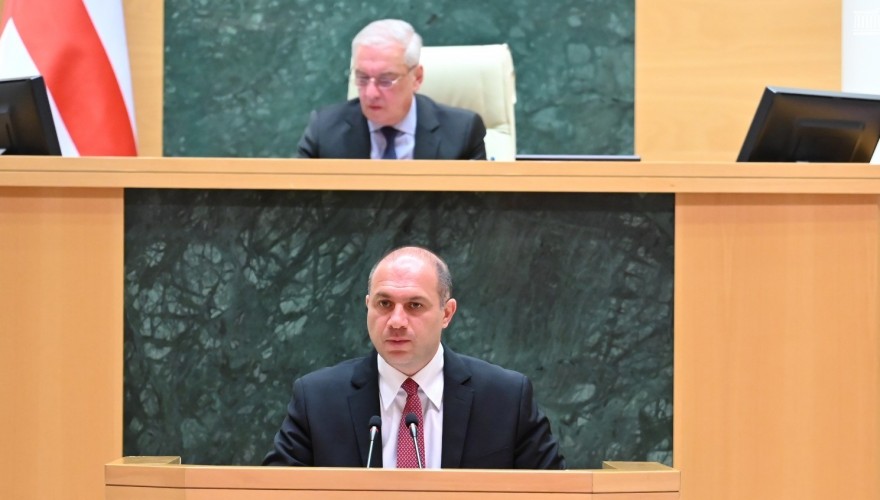
At the plenary session of Parliament, the Education, Science and Youth Minister, Givi Mikanadze, was heard through the interpellation procedure.
The Minister appeared before Parliament on the basis of a written request submitted by the parliamentary faction “For Georgia”.
Most of the questions concerned higher education reform and financing policy, including the new funding rules, model and methodology, personnel policy within the framework of the reform, higher education programs, and the overall reform concept.
In addition to higher education reform, the questions addressed to the Minister also covered issues related to general education reform.
“The reforms initiated by the Government of Georgia are fundamental, and we will certainly see their positive results for the benefit of our country and society”, - stated Givi Mikanadze.
According to him, 9 out of the 44 questions submitted by the faction fell entirely outside the mandate of the Ministry of Education, Science and Youth.
Givi Mikanadze stated that the new higher education financing model is based on a two-component system, which on the one hand ensures the institutional sustainability and financial autonomy of state universities, and on the other hand promotes development oriented toward quality, results, and national priorities.
As he noted, state universities will be financed from two main sources — basic funding and performance-based funding. According to the Minister, this model creates the foundation for state financing to focus not only on increasing access to higher education, but also on improving educational quality, strengthening research potential, and ensuring the long-term institutional development of universities.
“It is important that at higher educational institutions established by the Government of Georgia, the education of Georgian citizens in first- and second-cycle academic higher education programs will be fully financed by the state”, - the Minister stated.
According to him, the new higher education financing model takes into account the varying costs of academic programs according to fields of study and levels of higher education, defines a diversified financing scheme, and provides university funding based on student enrollment numbers in order to cover basic expenses related to the educational process and student services.
The Minister explained that the cost of each educational program was determined on the basis of assessing its specific characteristics, resource needs, and quality assurance requirements.
As for the performance-based funding component, it includes strategic areas such as educational quality and alignment with labor market demands, improvement of research and innovation quality, and the promotion of internationalization and regional development.
“The introduction of the proposed financing model will create the basis for state universities to develop educational programs aligned with labor market and national development priorities, ensure high-quality teaching and research environments, and create dignified and competitive remuneration conditions for academic, administrative, and support staff”, - stated the Minister.
Responding to questions regarding the applicants’ handbook, Givi Mikanadze noted that applicants were fully provided with opportunities both to receive information and to properly prepare and register for examinations.
The Minister also answered questions raised by the initiators of the interpellation regarding Sokhumi State University.
According to his explanation, within the framework of the higher education system profile concentration policy implemented by the Government of Georgia, institutional strengthening of agricultural education and research directions is being carried out precisely on the basis of Sokhumi State University.
“This decision is based on the principles of effective, rational, and targeted use of public resources, the state interest in developing agricultural education and research, and the policy of profile specialization and institutional strengthening within the higher education system”, - stated the Minister.
According to him, the use of educational, infrastructural, and laboratory resources is carried out on the basis of a relevant memorandum signed between the universities, in full compliance with current legislation.
As for human resources, the Minister explained that personnel-related relations are regulated on the basis of the relevant law and individual labor agreements.
He also stated that the accredited agricultural educational programs of the Georgian Technical University continue to operate in a gradual transition mode in full compliance with current legislation, and therefore these programs are not under threat.
As the Minister noted, the reform in personnel policy aims at the more effective use of academic resources.
“The goal of the reform is not to evaluate the activities of individual academic staff members, but to create an institutional environment that ensures the maximum concentration of academic resources within one university. At the same time, the reform will expand opportunities for the professional development of academic staff and increase the competitiveness of the system”, - Givi Mikanadze stated.
The Minister also emphasized the consideration of labor market demands in the process of determining university admission quotas.
According to his explanation, admissions for 21,600 students were announced in 2026.
Givi Mikanadze also provided Members of Parliament with information about ongoing processes within the framework of general education reform.
The discussion included the introduction of the “tutoring” approach in the 11th grade.
The Minister highlighted the importance of closer integration between general and vocational education.
As for the 12th grade, according to him, this issue remains an optional component for students.
Givi Mikanadze also spoke about the importance of supporting teachers’ professional development and introducing a new school financing model. He focused on piloting the new school financing model and the policy of introducing new personnel into schools.
The Minister also discussed the renewal of textbooks and the introduction of the “single textbook” principle in order to ensure state quality standards.
“Our goal is for decisions to be based on research, data, and real needs. Practically every major initiative is based on research, broad participation, a piloting stage, and final implementation”, - stated Givi Mikanadze.
In accordance with the Rules of Procedure of Parliament, after the Minister of Education, Science and Youth delivered his speech, the interpellation continued in a question-and-answer format.